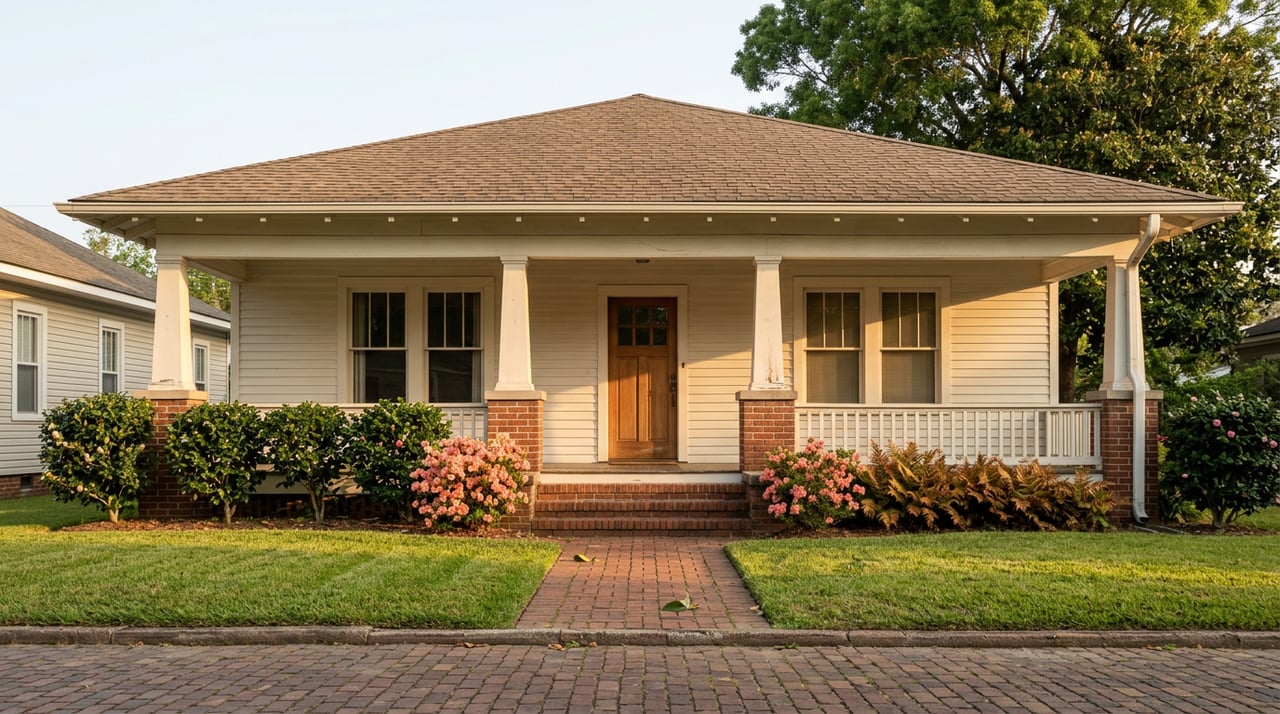
Orlando's Historic Bungalow Buyers Are Caught Between Two Insurance Rules Moving in Opposite Directions
August 13, 2026
August 13, 2026
Florida changed two insurance rules for older homes this year, and they point at each other. The age at which a home needs a four-point inspection has been quietly climbing, which sounds like good news for anyone buying a 1928 bungalow. At the same time, the state rewrote the wind mitigation form for the first time in more than a decade, and the new version asks for more proof than most homes built before 1960 can produce. For a buyer under contract on a brick-street property in College Park or Delaney Park, that combination shows up as a real surprise in the insurance quote, usually with less runway to fix it than the closing date allows.
This matters most in the neighborhoods where Orlando's oldest housing stock actually lives, and where the same construction that makes a home desirable is the construction an insurer scrutinizes hardest.
College Park earned its name from streets platted for institutions of higher learning, including Princeton, Harvard, and Yale, and it filled in fast during the Florida real estate boom of the 1920s, when the city pushed its northern boundary out to Par Street to bring the area inside city limits. Subdivisions like Dubsdread, platted in 1923, and Edgewater Heights, platted the following year, produced the bungalows and Tudor-style homes that still line those blocks. Astronaut John Young grew up on West Princeton Street, and Jack Kerouac was living on Clouser Avenue when On the Road was published, which is the kind of detail that tells you how long this neighborhood has been someone's home rather than someone's investment.
South of downtown, Delaney Park carries traditional homes built from the 1920s through the 1960s around a park the city renamed in 1959, with oak canopy over brick streets that give the neighborhood its character. A few blocks east, Lake Eola Heights has been a National Register historic district since 1992, with 487 contributing historic buildings inside its boundaries. Thornton Park rounds out the cluster with its own mix of early-1900s homes and later infill.
None of this is news to anyone who has shopped these streets. What is less obvious is that a home old enough to carry this kind of history is, almost by definition, old enough to trigger the exact underwriting checks that changed shape in 2026.
A four-point inspection looks at four systems only, roof, electrical, plumbing, and HVAC, and it exists purely so an insurer can decide whether to write or renew a policy. It is not a substitute for a full home inspection and was never meant to be.
For years, 20 years old was the rough line where carriers started asking for one. That line has moved. Any home 40 years or older will almost certainly need a four-point before a new carrier will write the policy, and most companies require one at 30 years, while the hard 20-year cutoff that used to be universal has loosened at several carriers, Citizens included. Some insurers have pushed their threshold back to 25 or 30 years this year, which gives a 1940s College Park bungalow a slightly easier path to a quote than it had two years ago.
The part that hasn't loosened is roof age. It remains the single biggest reason a Florida home gets declined or restricted at underwriting. A shingle roof past 19 years is a hard stop at most carriers, with some cutting that off as low as 12 to 15 years, while tile and metal roofs get more runway, typically up to 40 years. Where a shingle roof is aging out, some carriers are now offering a middle path: an actual cash value roof endorsement that covers the roof at depreciated value instead of full replacement cost, which beats a flat decline but changes the math on what a claim actually pays out.
A standalone four-point inspection runs $75 to $150 in most Florida markets, and a wind mitigation inspection costs about the same, so ordering them at the same visit typically costs less than paying for each separately.
This is where the contradiction lands. Beginning April 1, 2026, every wind mitigation inspector in Florida had to switch to a revised version of the Uniform Mitigation Verification Inspection Form, known as OIR-B1-1802 (Rev. 04/26), approved by the Florida Cabinet in September 2025. It was the first substantial rewrite of the form in over a decade, built on a 2024 residential wind-loss study that updated research conducted years earlier when the mitigation discount program was still new.
The new form adds fields that didn't exist before, including design wind speed and roof slope, and it leans much harder on documentation. Inspectors now need clearer photos and supporting paperwork for nearly everything they check, and if a feature can't be proven with a permit, invoice, or product approval, it often doesn't count toward a credit even if it's visibly there. That is a real problem for a home built in 1928, where the original roof-to-wall connections and window installations predate any permit record the county still holds.
None of this guarantees a discount either way. A wind mitigation inspection documents eligible construction features, but it does not guarantee a specific insurance premium credit, since each carrier applies its own underwriting rules to whatever the form shows.
There is one piece of relief for existing homeowners. The form is valid for up to five years if no material changes have been made to the structure, and Citizens Property Insurance has said it will continue to accept the prior version of the form if it was completed within five years before April 1, 2026, and nothing about the home has changed since. Submit an outdated form outside those conditions, though, and an agent can face a performance violation, which is a detail worth knowing if you're buying a home where the seller's existing report is close to that boundary.
Here is the shape of the contradiction in one place:
| What changed in 2026 | Direction for older homes |
|---|---|
| Four-point inspection age threshold | Loosened, from a common 20-year cutoff to 30 or 40 years at many carriers |
| Wind mitigation form documentation | Tightened, with new fields and stricter photo and permit proof requirements |
| Roof age as a decline factor | Unchanged, still the top reason for decline or restricted coverage |
If you're writing an offer on a home in one of these neighborhoods, order the four-point and wind mitigation inspections together during your option period, not after. Ask the seller directly whether an existing wind mitigation report is on file and when it was completed. If it predates April 1, 2026, and the home hasn't been touched structurally, some carriers will still honor it inside that five-year window, but others may ask for a fresh inspection under the new documentation standard, particularly if the original report is thin on supporting proof.
Check the roof before anything else. A tile or metal roof buys real time with most carriers, while an aging shingle roof, especially one approaching or past 19 years, is the item most likely to produce either a decline or an ACV endorsement instead of full replacement coverage. If the seller has any paperwork on prior roof work, permits, invoices, or manufacturer product approval, gather it before the inspector arrives. Even partial documentation reduces the odds of a follow-up request that stalls underwriting past your closing date.
None of this should scare a buyer away from a brick street in Delaney Park or a Craftsman bungalow off Edgewater Drive. It should change when you start the insurance conversation, which is the point where most surprises in these transactions actually originate.
Does a four-point inspection replace a full home inspection? No. A four-point looks only at roof, electrical, plumbing, and HVAC for insurance underwriting purposes. A full home inspection covers the entire property and is what actually tells you what you're buying.
If the seller already has a wind mitigation report, do I still need a new one? Not automatically. If it's within five years of completion and the home hasn't changed, some carriers will accept it as is. Others may ask for an updated report if the documentation doesn't meet the new form's standard or if your specific carrier requires it.
Will the new wind mitigation form guarantee a lower premium? No. The form documents what's present on the home. Each insurer decides independently whether and how much credit to apply based on that documentation.
Buying in one of Orlando's older neighborhoods means buying a piece of the city that can't be replicated, and it also means starting the insurance conversation earlier than a newer build would require. If you're weighing a bungalow in College Park, a colonial revival in Delaney Park, or anything else built before the systems inside it were standardized, Anthony L. Santos can walk through the inspection timeline with you before you're locked into a contract deadline. Get in touch and let's map out what your specific property will need before you write the offer.
Stay up to date on the latest real estate trends.
Whether you are a first-time buyer, a seasoned investor, or somewhere in between, I bring the market knowledge and personal attention that make all the difference.

ADDRESS 350 North Lake Destiny Rd # 116 Maitland, FL 32751