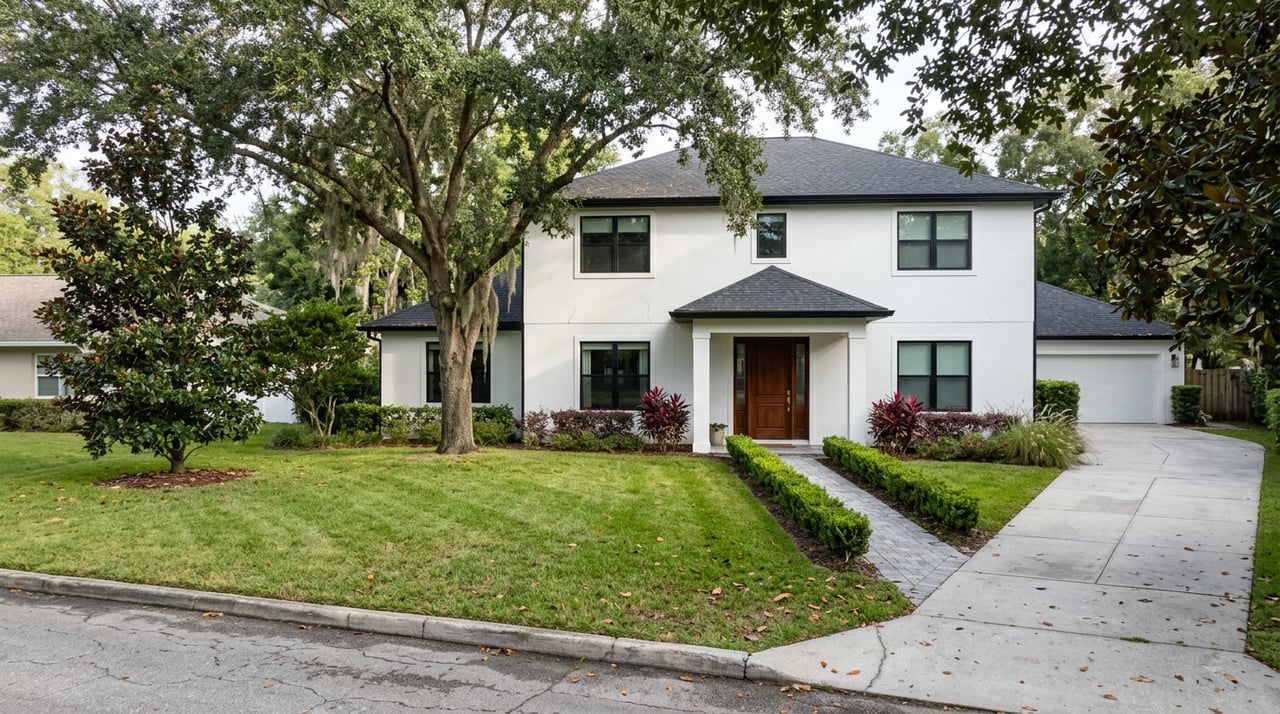
The $150,000 Bungalow Gap Between Delaney Park and Colonialtown North Isn't Really About the Bungalows
September 17, 2026
September 17, 2026
Why does a 1920s bungalow in Delaney Park carry a median price of roughly $624,000 to $649,000 as of early 2026, while a bungalow of the same era in Colonialtown North sells for a median closer to $468,000 to $482,000 over the same stretch? Pull up both zip codes side by side, 32806 and 32803, and the gap looks like a straightforward verdict on which neighborhood buyers want more. It isn't. Once you look at what each number actually captures, the story changes, and so does the math a buyer should be running before writing an offer.
Delaney Park and Colonialtown North sit a few miles apart, both inside Orlando's historic urban core, both built out substantially between the 1920s and 1950s with craftsman bungalows, colonial revivals, and mid-century ranch homes on tree-lined streets. Delaney Park runs along brick-lined roads a mile and a half south of downtown, anchored by the 7.25-acre Delaney Park green space itself, originally platted as Duckworth Park and renamed in 1959. Colonialtown North sits north of downtown along the edge of the Mills 50 dining district, with pockets like Coytown carrying their own identity within the larger neighborhood boundary.
If housing stock alone set the price, these two neighborhoods should land closer together than they do. They share the same construction decades, the same walkable brick-and-oak-canopy character, and the same general distance from downtown Orlando. The $150,000 spread between their headline medians suggests something else is doing the work.
Look at Colonialtown North's data closely and the median starts to look less like a single market and more like a median shaped by several different product types.
On the low end, Colonialtown North carries a real mix of duplex conversions and small multifamily product. A recently sold 8-unit multifamily property and a listed duplex unit on La Salle Avenue show up in the same data pool as detached single-family homes. On the high end, builders have been actively infilling the neighborhood with new spec construction: David Weekley Homes has a project under construction on a quiet Colonialtown North street, and LUIH Luxury Homes has listed a new five-bedroom, 4.5-bath residence in the neighborhood's core. New single-family builds in the area run as high as $1 million, while renovated early-to-mid-century bungalows typically list between $400,000 and $700,000, and new-construction townhomes run roughly $430,000 to $600,000.
That's three distinct products selling inside one reported median: a legacy bungalow, a new luxury spec home, and a townhome or duplex. The median across all three product types may describe none of them particularly well.
The days-on-market figures make the same point from a different angle. Recent Colonialtown North sales through February 2026 moved in about 36 days on average, down from 52 days the year before, a pace that looks brisk and competitive. But a trailing 12-month figure through mid-2026 puts average time on market above 180 days, and a separate look at Colonialtown North townhomes specifically shows them sitting for around 177 days at a median price of $537,000. Those aren't contradictory measurements of the same market. They're different slices of a neighborhood where fast-moving renovated bungalows and slow-moving new-construction townhomes are getting folded into a single average.
Delaney Park's numbers don't split the same way. Median sale price sits in the $624,000 to $649,000 range as of early 2026 across separate estimates, and average time on market lands consistently around 62 to 65 days no matter which snapshot you check. That consistency isn't an accident. Delaney Park's inventory is overwhelmingly one thing: single-family detached bungalows and colonial revivals on traditional lots, with entry-tier homes starting near $390,000 and fully renovated historic estates reaching past $1 million on the high end. There's no duplex conversion pulling the floor down and no wave of new-construction townhomes pulling a chunk of the market toward a different price tier. One product, one number, and the number holds together.
Set the medians aside and compare the specific product a buyer is likely shopping for, a renovated 1920s to 1950s bungalow, and the gap mostly disappears. Colonialtown North's renovated bungalows run $400,000 to $700,000. Delaney Park's comparable stock starts near $390,000 and runs through the same middle band before climbing toward the higher end reserved for brick-street addresses and larger renovated estates. The headline medians make it look like Colonialtown North offers a $150,000 discount on the same house. The bungalow-to-bungalow comparison says the discount, if it exists at all, is much smaller and depends entirely on which specific product you're pricing against which.
There's a second layer of variation inside Colonialtown North that Delaney Park doesn't have to deal with: school zone assignment isn't uniform across the neighborhood. Most of Colonialtown North feeds into Audubon Park K-8 and Edgewater High School, but addresses in the Coytown pocket can be zoned for Audubon K-8 paired with Winter Park High School instead, a different high school entirely. Two homes a few blocks apart, same era, same renovation level, can carry different school assignments and therefore different demand curves, which adds one more variable stacked into a single neighborhood median.
Delaney Park doesn't have this problem. The feeder pattern is consistent across the neighborhood: Blankner K-8, a PK-through-8th-grade campus on South Mills Avenue that keeps students on one campus through middle school, followed by Boone High School, whose Criminal Justice, Law & Finance magnet program has been named a national honoree by Magnet Schools of America. Whatever a buyer thinks of that program, it's the same assignment for every Delaney Park address, which is one less source of noise in the neighborhood's price data.
Delaney Park's other pull is proximity to Orlando Regional Medical Center, close enough that it functions as the only established single-family neighborhood within walking distance of the hospital, a real draw for physicians, residents, and hospital staff who value a short commute over new-construction finishes.
Colonialtown North's pull runs through Mills 50 and the neighborhood's own small parks. Bánh Mì Ý Như and the Michelin Guide-recognized Tori Tori sit within walking distance for much of the neighborhood, alongside Lamp & Shade and Will's Pub for evenings out. Colonialtown Square Park and Colonialtown Park, the latter next to the Colonialtown Neighborhood Center, give the area its own green space even without a single anchor park the size of Delaney Park's.
Neither neighborhood's listings mentioned mandatory homeowners association dues tied to the historic bungalow stock in either area. That's typical of Orlando's legacy platted neighborhoods, built before community associations became standard on new subdivisions, and it's worth confirming on any specific address rather than assuming, since a handful of newer townhome and condo products built into both neighborhoods do carry their own association structures.
A buyer who sees Colonialtown North priced $150,000 below Delaney Park and assumes that gap will show up in their own offer is comparing the wrong things. The real question isn't which neighborhood's median is lower. It's which specific product, a renovated bungalow, a new spec build, or a townhome, you're actually trying to buy, and what that product costs within the neighborhood you're considering rather than across it.
Before treating either neighborhood's advertised median as a planning number, it's worth asking a few things directly: is the comparable sale a detached single-family bungalow or a townhome/duplex product, what specific address and school zone does the listing carry within the neighborhood, and how long has that specific product type been sitting on the market rather than the neighborhood average. Those questions turn a headline number into something you can actually use to plan an offer.
Working through comparisons like this with someone who knows the specific streets, not just the zip codes, is where a lot of that clarity comes from. If you're weighing Delaney Park against Colonialtown North, or any other pair of Central Florida neighborhoods that look similar on paper, Anthony L. Santos can walk through what the current listings in each actually represent before you get attached to a number that may not mean what it looks like it means. Get in Touch to start that conversation.
This article is general information, not legal, tax or financial advice. Consult a qualified professional about your situation.
Stay up to date on the latest real estate trends.
Whether you are a first-time buyer, a seasoned investor, or somewhere in between, I bring the market knowledge and personal attention that make all the difference.
ADDRESS 350 North Lake Destiny Rd # 116 Maitland, FL 32751